
Beyond the Monthly Payment: Your Legal Rights and Lease-End Costs in California (2026 Guide)
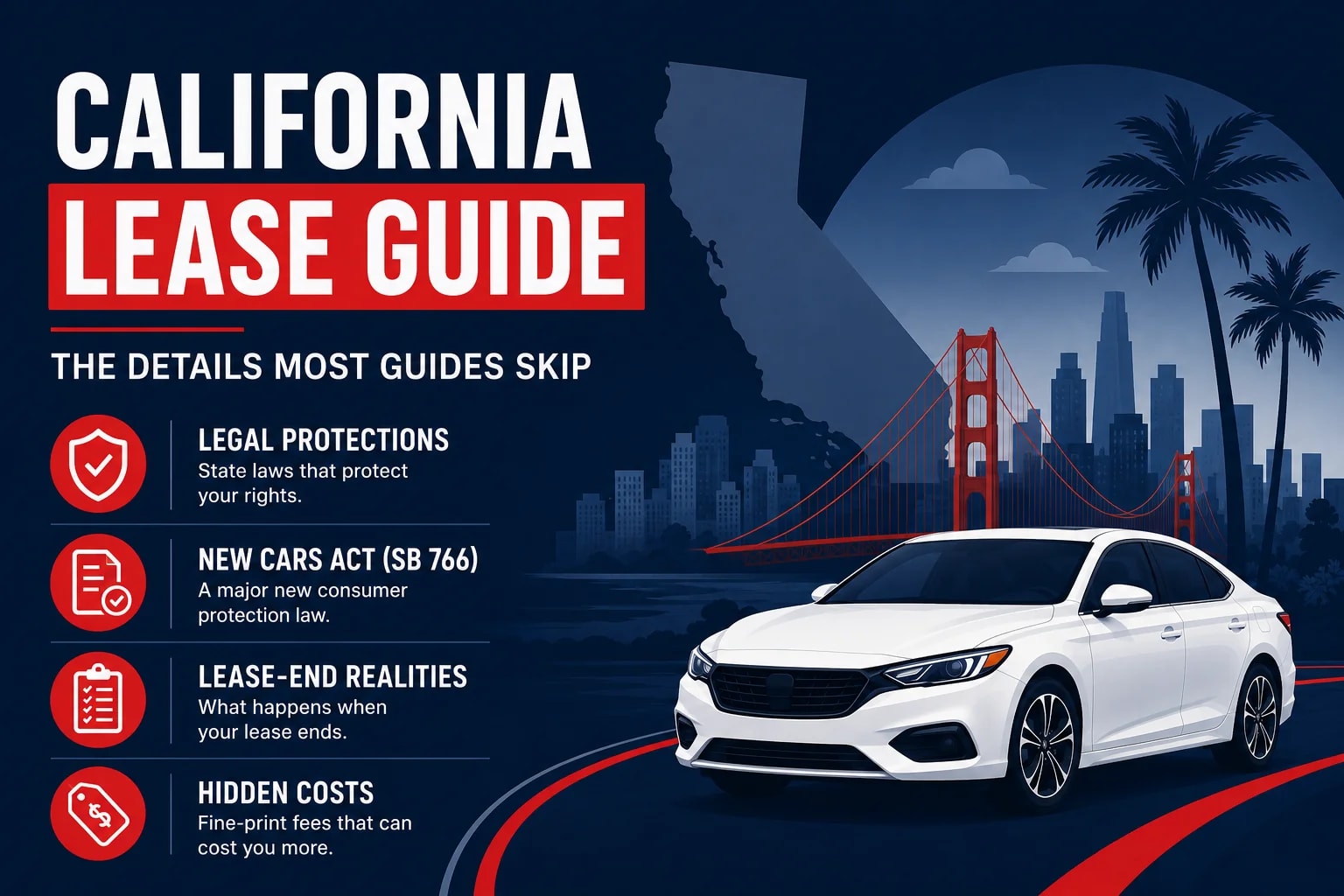
Most California car-lease guides stick to the same handful of topics: monthly payments, credit tiers, EV incentives, sales tax. That’s useful information, but it only covers how to get into a lease. It doesn’t cover what happens during the lease, or when it ends, and that’s usually where California drivers get caught off guard.
This guide covers the parts that tend to get left out: the state-specific legal protections you have as a lessee, a major new consumer protection law that just took effect, what actually happens at lease-end, and a few fine-print costs that rarely show up on a rate sheet. For the basics of leasing in California, monthly payment ranges, and current lease specials, see AutoBandit’s California leasing page.
California Has Its Own Lease-Specific Consumer Protection Laws
Leasing a car in California isn’t governed only by the contract you sign. State law also limits what dealers and leasing companies can do, and what they have to disclose.
The Rees-Levering Act
The Rees-Levering Automobile Sales Finance Act is one of California’s oldest and strongest vehicle finance protection laws. It was written to stop dealers from using cleverly worded contracts to sidestep the consumer protections that apply to conditional sale and lease agreements. The full text of the law is codified in the California Civil Code, sections 2981 through 2984.6. A few things it does in practice:
Requires specific, itemized disclosures in your lease contract rather than vague or bundled terms.
Sets strict rules for what happens if your leased vehicle is repossessed, including required “Notice of Intent” paperwork before a lender can come after you for remaining balances.
Has been the basis for numerous class-action settlements against major auto lenders over defective repossession notices, with settlements over the years providing consumers well over a billion dollars in debt relief.
If your leasing company ever repossesses your vehicle or threatens to pursue you for a “deficiency balance” after early termination, this law gives you specific procedural rights they’re required to follow. If they don’t follow them, you may have grounds to challenge the debt.
A Major New Law Just Took Effect: The CARS Act (SB 766)
This is arguably the biggest change to California’s vehicle sale and lease law in close to twenty years, and you won’t find it mentioned on most lease comparison pages because it’s so new. Signed in 2025, the California Combating Auto Retail Scams Act (SB 766) took effect on October 1, 2026. Here’s what it changes for anyone leasing a car in the state:
A 3-day right to cancel. For qualifying used-vehicle leases priced at $50,000 or less, you now have a three-day window to cancel the transaction. The statute counts three calendar days starting the day after you sign, and the right doesn’t apply once the vehicle has been driven more than 400 miles. Dealers are allowed to charge a restocking fee if you use this right, capped by statute at 1.5% of the vehicle price with a $200 floor and a $600 ceiling, but the right itself can’t be waived.
Add-on product transparency. Dealers now have to disclose clearly and conspicuously, in writing, that add-on products such as extended warranties, GAP waivers, tire and wheel protection, or paint sealant are optional and that you can lease the vehicle without them.
No charging for add-ons that don’t do anything. The law specifically targets junk products, including nitrogen-filled tire products that contain less than 95% nitrogen purity, marketed as an upgrade when they don’t deliver meaningfully more nitrogen than regular air.
Honest payment comparisons. When a dealer shows you multiple monthly payment options side by side, they’re now required to disclose that lower monthly payments often increase the total amount you’ll pay over the life of the deal.
Wider disclosure coverage. Before this law, many of these disclosure requirements only applied to financed purchases. SB 766 extends them to lease and cash transactions too and broadens the scope to cover all dealer add-ons.
In practice, this means you’re entitled to a clean breakdown of what’s actually required to lease the car versus what’s being upsold. If a finance manager tells you an add-on is mandatory, there’s now a specific law backing you up if you want to decline it.
What Actually Happens at Lease-End
This is the part that gets skipped most often, and it’s where unexpected costs tend to show up.
The inspection
Somewhere around 60 to 90 days before your lease ends, most leasing companies will schedule (or let you schedule) a pre-return inspection, usually through a third-party company. They’re checking for:
Excess wear and tear: dents, scratches beyond a certain size, cracked glass, upholstery stains, aftermarket modifications.
Missing equipment: spare tire or repair kit, floor mats, manuals, both sets of keys or fobs.
Excess mileage: your actual total compared against the annual allowance in your contract, prorated to your return date.
Normal wear, meaning minor scuffs or small stone chips, is usually excluded, but leasing companies vary quite a bit in how strictly they define “normal.” Taking your own dated photos before the inspection is a good habit.
The disposition fee
Nearly every lease contract includes a disposition fee, typically $300 to $500, charged when you return the vehicle instead of buying it out. It covers the leasing company’s cost to prep and resell the car. This fee is buried in the fine print of the original contract, it’s essentially non-negotiable, and it rarely shows up in rate comparisons.
Your options when the lease ends
Return the vehicle and walk away, subject to the wear, mileage, and disposition charges above.
Buy out the lease at the residual value stated in your contract. In California, buying out your own leased vehicle generally triggers sales tax on the buyout price, based on current California Department of Tax and Fee Administration guidance. That’s a separate tax event from the monthly lease tax you already paid, so it’s worth factoring into your buyout math ahead of time.
Trade it in toward a new lease or purchase. The dealer pays off your residual, and if the car is worth more than the payoff, that positive equity can go toward your next deal.
What early termination really costs
Ending a lease before the term is up usually triggers an early termination charge, calculated from the gap between your remaining payments and the vehicle’s current market value, plus whatever early-termination fee is written into the contract. This can run into the thousands of dollars pretty easily. Two ways to avoid it:
Lease transfer or swap. Some leasing companies let another qualified person take over your remaining payments. Not every manufacturer allows this, so it’s worth checking with your specific lender, but it can sidestep the early-termination penalty entirely.
Third-party lease transfer marketplaces. These exist specifically to match people trying to exit a lease early with people looking for a shorter-term one.
GAP Coverage Is Often Assumed, Rarely Explained
Most leases automatically bundle Guaranteed Asset Protection (GAP) coverage into the lease payment, but not all of them do, and this detail rarely gets pointed out to shoppers.
GAP coverage matters because a leased vehicle’s payoff balance (what you’d owe if it were totalled or stolen) is often higher than what a standard auto insurance policy pays out, since insurance covers actual cash value rather than the contract balance. Without GAP coverage, you could end up personally responsible for that gap, sometimes several thousand dollars, after a total loss.
Before signing, ask specifically whether GAP is bundled into your lease or being sold separately as an add-on. If it’s an add-on, current law requires the dealer to tell you clearly that it’s optional.
Smog Checks and Leased Vehicles
New vehicles in California don’t need a biennial smog test right away. According to the California DMV’s smog inspection rules, gasoline vehicles less than eight model years old are exempt from the biennial inspection, and owners of vehicles less than four model years old pay a smog abatement fee at registration renewal in place of an inspection for the first eight years the vehicle is registered. Either way, that covers nearly every standard two- to three-year lease term.
Where this catches people off guard: those windows apply to registration renewal, not to selling or transferring a vehicle. If you buy out your lease later, or the car changes hands, a different rule tied to four model years applies, and a smog transfer fee can come into play. It’s a small distinction, but worth checking against your registration notice or the DMV site rather than assuming leasing means no emissions paperwork at all.
Using a Leased Vehicle for Rideshare or Delivery Work
If you’re thinking about using a leased car for Uber, Lyft, DoorDash, or similar platforms, check the lease contract first. Many standard consumer leases explicitly prohibit commercial use, including rideshare and delivery driving. Violating that clause can void portions of your coverage, create a dispute at lease-end over “commercial wear,” or in some cases breach the contract outright.
Some manufacturers offer separate commercial-use lease or subscription products built for rideshare drivers. If that’s the plan, it’s worth asking about those programs upfront instead of leasing a standard consumer vehicle and hoping nobody notices.
Negotiating the Numbers Dealers Don’t Volunteer
Rate comparison pages usually just show you a final estimated monthly payment. Two numbers behind that figure determine it, and both are negotiable:
Capitalized cost (cap cost). This is effectively the car’s “price” for lease purposes. Like a purchase price, it can be negotiated down from MSRP, something a lot of shoppers don’t realize since lease pricing can feel fixed.
Money factor. This is the lease equivalent of an interest rate, usually written as a small decimal like 0.00125. Multiply it by 2,400 to get a rough APR equivalent. Your credit tier sets the baseline money factor a lender offers, but dealers sometimes have room to mark it up, so asking for the “buy rate” (the lender’s actual rate before any dealer markup) can save real money over the term.
Acquisition fees, charged by the leasing company to originate the lease and often $500 to $1,000, are also usually non-negotiable, but they should be confirmed upfront, so they don’t show up as a surprise on your first bill or Truth-in-Leasing disclosure.
Frequently Asked Questions
Do I have a right to cancel a car lease in California after signing?
As of October 1, 2026, under the CARS Act, you have a three-day right to cancel qualifying used-vehicle purchases or leases priced at $50,000 or less. The window runs three calendar days from the day after you sign, and it doesn’t apply once you’ve driven more than 400 miles. This is a new right that didn’t exist in California before this law.
What happens if I go over my mileage limit at lease-end?
You’ll pay a per-mile overage fee written into your original contract, typically somewhere between $0.15 and $0.30 per mile, calculated against your actual mileage versus your contracted allowance.
Is GAP coverage required in California?
Not by state law, but most leasing companies build it into standard contracts. If it’s sold separately as an add-on, current law requires the dealer to disclose that it’s optional.
Can a California dealer force me to buy an add-on product to get a lease deal?
No. Under the CARS Act, dealers must clearly disclose that add-ons like extended warranties, paint protection, or tire and wheel coverage are optional, and they can’t misrepresent them as mandatory.
What’s a disposition fee, and can I avoid it?
It’s a fee, typically $300 to $500, charged when you return a leased vehicle instead of buying it out. It covers the leasing company’s resale prep costs, and it’s set in your original contract, so it’s generally not negotiable. It doesn’t apply if you buy out the lease or trade it in toward a new vehicle with the same lender.
Can I use a leased car for Uber or Lyft in California?
Only if your lease contract allows commercial use. Many standard consumer leases don’t, so check your contract or ask about manufacturer-specific commercial lease programs before using a leased vehicle for rideshare or delivery work.
Do I have to pay sales tax again if I buy out my lease?
Yes. Buying out a leased vehicle in California counts as a separate purchase transaction, so sales tax applies to the buyout price even though you already paid tax on your monthly lease payments.
This article is for general informational purposes and isn’t legal advice. Lease terms vary by manufacturer and lender, so always review your own agreement, and consult a consumer protection attorney if you believe your rights under the Rees-Levering Act or CARS Act have been violated.
Latest Posts
Ready to Take the Wheel? Explore Leasing Options
Lease by Model
Lease by Make
Lease by State

